
A solar distributorship can look like a straightforward business. Buy products from a manufacturer, supply them to installers, and earn a margin on every order.
But there’s more to it than moving boxes from one warehouse to another.
Your investment depends on how much stock you hold, the territory you cover, your customer base, credit terms, and the kind of products you distribute. Your margin depends on the same thing. A distributor handling large volumes works very differently from a dealer who sells and installs systems for end customers.
That difference matters when you’re calculating the real cost and potential return of a solar distributorship.
This guide explains how the distribution model works, what you may need to invest, where the margins come from, and what to check before you sign a distributorship agreement.
Who makes the equipment in the first place?
Everything in the chain begins with a manufacturer. They run the factory, carry the product warranty, and set the trade prices everybody downstream works from.
In India, this is a growing group, and Invergy is one example, manufacturing solar inverters and energy storage systems. Makers of panels, inverters, batteries, switchgear, and mounting systems all sit at this first position.
What matters for anyone considering distribution is that manufacturers rarely sell in small quantities. They want volume, forecasts, and payment terms that suit a factory. That requirement is why the next role exists at all.
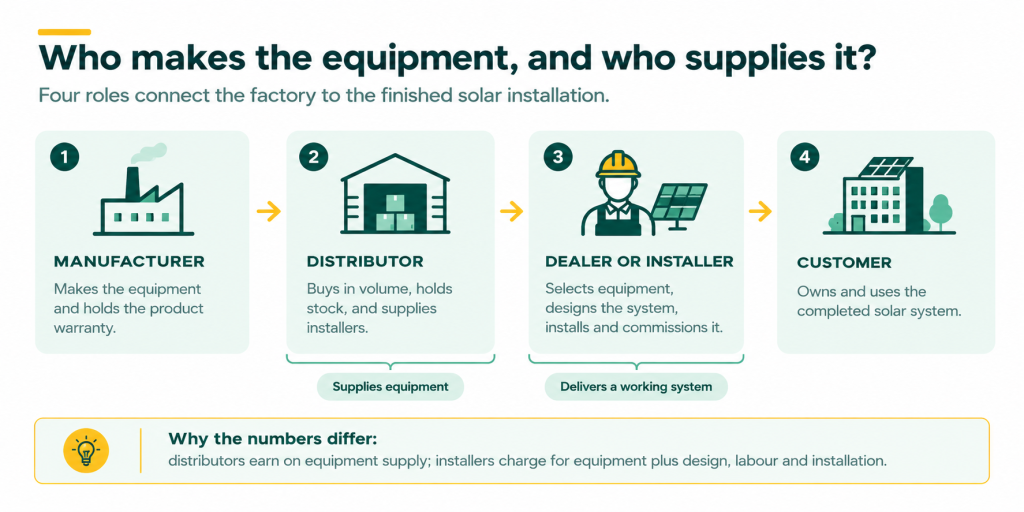
The solar supply chain has four main roles, and each serves a different purpose.
1. Manufacturer: Makes solar panels, inverters, batteries, and other equipment. The manufacturer sets product specifications and provides the product warranty.
2. Distributor: Buys equipment in bulk from manufacturers, maintains stock, and supplies products to dealers, installers, and EPC companies. The distributor earns through the margin on equipment sales and helps ensure products are available when projects need them.
3. Dealer or installer: Selects suitable equipment, prepares quotations, designs the system, and handles installation and commissioning. The installer charges the customer for the equipment and the work involved in delivering a functioning solar system.
4. Customer: Purchases the completed system for a home, commercial building, or industrial facility and uses the electricity it generates.
Why does this distinction matter?
A distributor and an installer may both be described as solar business partners, but their business models differ. Distributors focus on inventory, supply, and bulk sales, while installers earn from equipment sales and the services required to complete a project. This difference affects their investment, operating costs, margins, and potential returns.
What does a solar distributor actually do?
A distributor buys in volume from manufacturers and resells to the businesses that install. It does not usually touch a rooftop.
The work is holding stock and breaking large consignments into orders an installer can use. It is extending credit so a small firm can take a job before the customer has paid. It is moving product across a region fast enough that nobody’s project stalls waiting for an inverter.
This business requires significant working capital. A distributor’s real value lies in keeping products in stock and getting them to installers when they need them.
What does a dealer or installer do instead?
A dealer sells to whoever will own the installation. That means sizing it, quoting it, buying the equipment, installing it, getting the net metering approval through the electricity company, and answering the phone for years afterwards.
Larger work sits at the same end of the chain at a different scale. Turnkey contractors take a project from design through to handover and buy through the same distribution layer. GPES Green Projects works on turnkey EPC solutions and project management consultancy of this kind, and GPES Solar runs its own solar EPC alongside distribution.
The commercial difference is simple. A distributor earns a margin by supplying equipment, while an installer charges the customer for the complete solar installation, including equipment, design, labour, mounting, wiring, and commissioning. The customer pays for both the hardware and the work required to get the system up and running.
What does it cost to start, and what can you earn?
This is the question everybody arrives with, and the honest answer is that it depends entirely on which of the two roles above you mean.
The investment depends on which side of the solar supply chain you want to enter. If you’re planning to start a solar business, a dealership or installation business generally requires less capital than a full-scale distributorship, though the actual amount depends on your setup.
For a dealership or installation business, manufacturer recruitment pages quote entry points of around ₹25,000, while franchise portals cite ₹15 lakh to ₹70 lakh for a larger setup with a showroom and staff. Equipment margins are often quoted at 10% to 15%, with some portals citing 20% to 35% for project execution. These figures describe different business models, so they should not be compared directly. Project execution includes design, labour, installation, and approvals, not just the sale of equipment.
A distributorship operates at a different scale. You buy products in bulk from manufacturers and supply dealers, installers, and EPC companies. One manufacturer’s guidance puts the investment for a distributorship with a well-known brand at ₹1 crore to ₹2 crore, along with warehouse capacity and an annual sales target of ₹15 crore to ₹20 crore. The cited margin is no more than 2%. For established solar professionals, the model may build on an existing installer network; for first-time entrants, the capital, inventory, credit, and sales commitments need careful assessment.
Both can be good businesses. A 2% margin on fifteen crore of turnover is thirty lakh. A 30% margin on forty lakh of installation work is twelve lakh. The percentages look nothing alike, and neither do the businesses behind them.
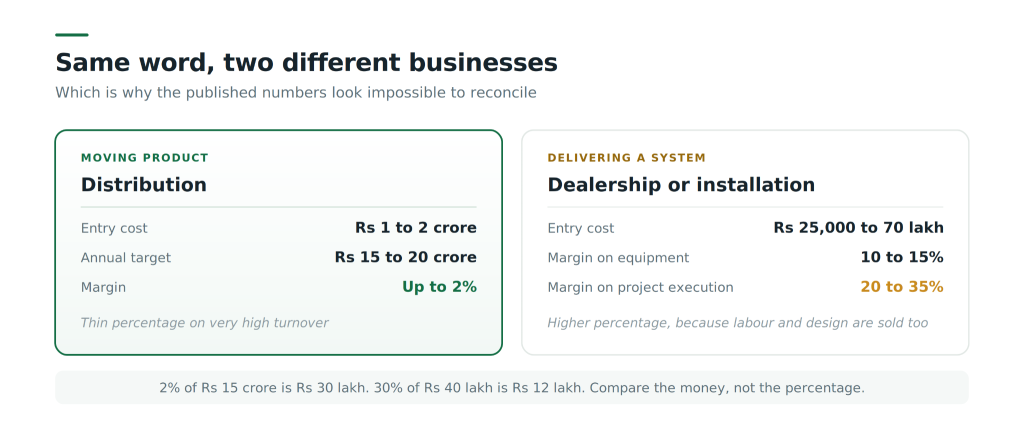
So the useful question is not “what margin do distributors make?” It is “which of these two jobs am I being offered, and on what turnover?”
What does a distributor actually pay for?
Three things, and none of them appear in a margin percentage.
- Stock that has been bought but not yet sold. Money sitting in a warehouse is money that cannot be used for anything else, sometimes for months.
- Prices move while stock sits. Solar equipment tends to get cheaper over time, so stock bought last quarter competes against this quarter’s lower price. Storage moves fastest of all, as our piece on the future of battery energy storage sets out.
- Keeping the stock compliant. Panels used in net-metered, subsidised or government projects must appear on a government-approved list, and lists are revised every few weeks. Stock can be bought when it qualifies and sold when it no longer does. The current lists are published on MNRE’s ALMM page.
This is the part of the job that customers rarely see. What an installer experiences is a delivery arriving on time with the right paperwork. What sits behind that is inventory management, warehousing, and a supply network wide enough to serve more than one region.
It is also the work behind a solar distribution network. We hold inventory, deliver against project schedules, work with global and domestic brands, and support customers on product fit and system compatibility. Whoever holds the stock holds the risk, and that cost never appears in a recruitment brochure.
What changed in the last year?
One thing worth knowing, because much published advice has not caught up with it.
The GST Council reduced the rate on renewable energy devices from 12% to 5% at its 56th meeting on 3 September 2025, effective 22 September 2025. The change is set out in the Government of India‘s press release on the meeting.
Turnkey contracts are treated as 70% goods and 30% services. On that split, the effective rate on a renewable energy contract fell from around 13.8% to about 8.9%.
That changes how every quotation in the chain is built. Yet pages published well into 2026 still describe 12% as the current rate for panels, and some still quote 18% on inverters. If a page cannot get a published tax rate right a year after it changed, its margin figures deserve the same scepticism.
What should you ask before signing anything?
Five questions separate a genuine supply arrangement from a recruitment pitch.
- What exactly am I buying? Stock at a trade price, or a territory and a brand kit. These are different transactions with different economics.
- What is the sales target, and what are the credit terms? Distribution runs on volume commitments and payment periods. If neither is mentioned in writing, you are probably being offered a dealership.
- Who carries stock that does not sell? The answer tells you where the risk sits.
- What happens on a warranty claim? Whether it goes back to the manufacturer, who handles it meanwhile, and how long the customer waits.
- Can you show the compliance documents? For solar modules, the approved-list status of the exact model, not the brand. For switchgear, design verification against the standard. Our guide to choosing electric panels and inverters covers what to ask for.
Our guide to choosing a solar supply partner goes through this in more detail.
Working with GP Eco Solutions
The most useful habit when reading about this business is to check which job a number describes before comparing it with another number. Distribution and installation are both legitimate ways to make money in solar. They need different capital, carry different risks, and pay differently. Content that blurs the two is not usually lying; it is selling.
If you are weighing up a solar distributorship, work through those five questions before committing to anyone. GP Eco Solutions sits in the distribution layer described above. We supply solar products to installers, EPC companies, and businesses across India, working with global and domestic brands. Our own range covers Invergy inverters and storage, SCADA monitoring, and LT and HT panels.
If you install or execute solar projects, our team can support you in finding the right fit, on system compatibility, and after the sale.
See what our distribution network covers, or talk to us about what you are building.
Frequently asked questions
What is the difference between a solar dealer and a solar distributor?
A distributor buys in bulk from manufacturers and supplies businesses that install. A dealer or installer sells and fits systems for end customers. The investment, the margin, and the daily work differ in each.
How much does it cost to start a solar distributorship in India?
Published figures vary because they describe different roles. Manufacturer guidance suggests one to two crore for a distributorship with a well-known brand. Dealership entry points start far lower, from around twenty-five thousand rupees.
Are solar distributor margins really 20% to 30%?
Those figures usually come from installation work, where labour and design are sold alongside equipment. Margins quoted for moving product with a well-known brand are closer to 2%.
What GST rate applies to solar equipment now?
Renewable energy devices moved from 12% to 5% with effect from 22 September 2025. For turnkey contracts, the effective rate works out at roughly 8.9%.
Do distributors need to worry about ALMM?
Yes, if their customers build net-metered, subsidised or government projects. Approved lists change regularly, so stock can be bought compliant and sold non-compliant.
Is a solar distributorship still worth taking on?
That depends on access to capital, warehousing and a customer base of installers. Demand is real. Margins on moving product are thinner than most recruitment content suggests.