
Two pieces of equipment decide how well a commercial electrical installation runs, and they are usually bought separately by people who never speak to each other.
The panel distributes and protects the power. The inverter, where there is solar on site, decides how much power arrives and in what form. Specify one without the other in mind, and the problems show up at commissioning, when they are expensive.
This guide covers what panels and inverters both do, the types available, and what to check before you sign an order.
What does an electric panel actually do?
A panel is switchgear. It receives incoming power, splits it into circuits, and protects each one on its way to equipment.
Sites have either one type or two, and the difference is where the panel sits relative to the transformer.
An HT panel, or high-tension panel, handles incoming high-voltage supply and provides switching, protection and metering before the transformer. An LT panel, or low-tension panel, distributes the stepped-down supply to equipment across the site.
The supply voltage depends on the site’s connected load and contracted demand, along with the applicable state electricity supply code. For example, the Gujarat Electricity Regulatory Commission’s Electricity Supply Code specifies 400 V three-phase supply for many smaller commercial and industrial connections, with 11 kV, 22 kV or 33 kV supply for higher demand levels. Sites receiving high-voltage supply generally require HT switchgear and a transformer before power reaches the LT distribution system.
Your electricity bill already names your connection. For the full comparison, including state load thresholds and where the 650 V and 1,000 V figures come from, see our guide to HT and LT panels.
What are the types of LT panels?
Four types cover most commercial and industrial sites.
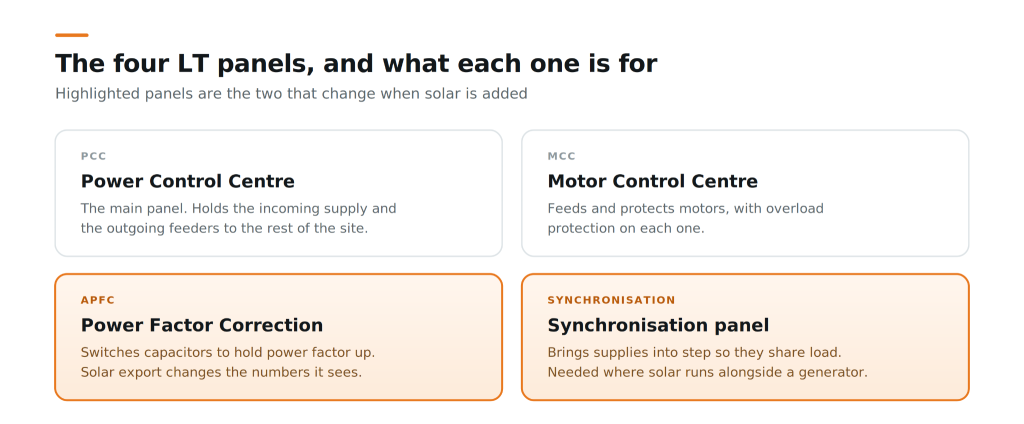
PCC, or Power Control Centre. The main panel, holding the incoming supply and the outgoing feeders.
MCC, or Motor Control Centre. Feeds and protects motors, with overload protection on each.
APFC, or Automatic Power Factor Correction. Switches capacitors in and out to hold the power factor up. On industrial sites, correct sizing and control can help manage reactive power and avoid power factor adjustment charges where the applicable tariff provides for them. With solar added, the APFC system may need to be reassessed to account for changes in grid-side power flows and billing.
Synchronisation panel. Brings two or more supplies into step so they can share load, for example a generator running alongside the mains.
On the HT side, the equipment is different rather than simply larger, built to different standards with different clearances and type tests. Our HT and LT panel range covers both sides.
What changes when you specify an LT panel for solar?
Quite a lot, and this is the part most buyers discover late.
On a rooftop plant, the inverter output joins on the load side of the transformer, feeding into the LT panel.
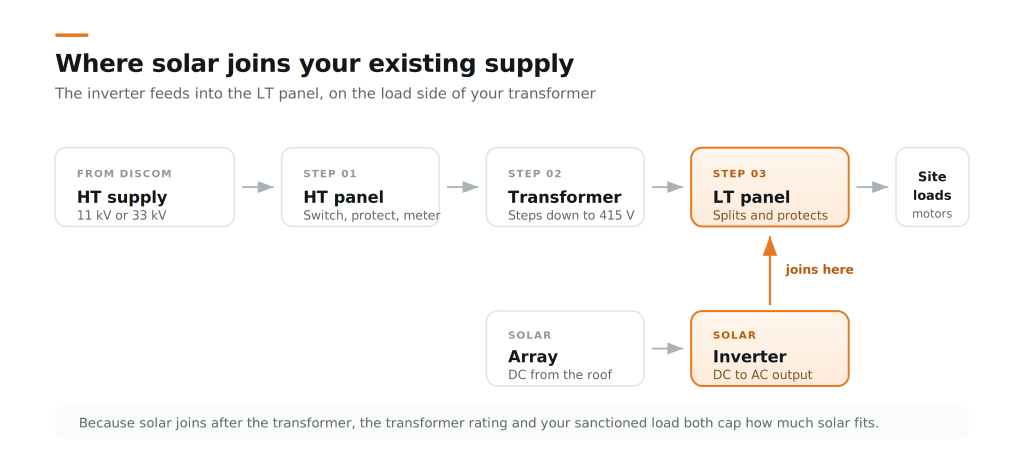
Three consequences follow.
Plant size is capped by the electrical system, not the roof. Because solar joins after the transformer, the transformer rating and your sanctioned load both limit how much solar the site can take. Check this before anything is ordered.
The panel becomes a junction. Power now arrives from two directions and has to be metered and protected in both.
Your power factor changes. The inverter supplies real power while the site’s reactive demand carries on unchanged, so an APFC scheme tuned before solar can end up over-correcting.
Ground-mounted plants exporting to the grid work the other way, with output stepped up and leaving through an HT panel. That sits in EPC territory, where the contractor handles the connection design.
What are the types of inverters?
The inverter arrangement decides what the panel has to handle, so this choice comes before the panel specification rather than after it.
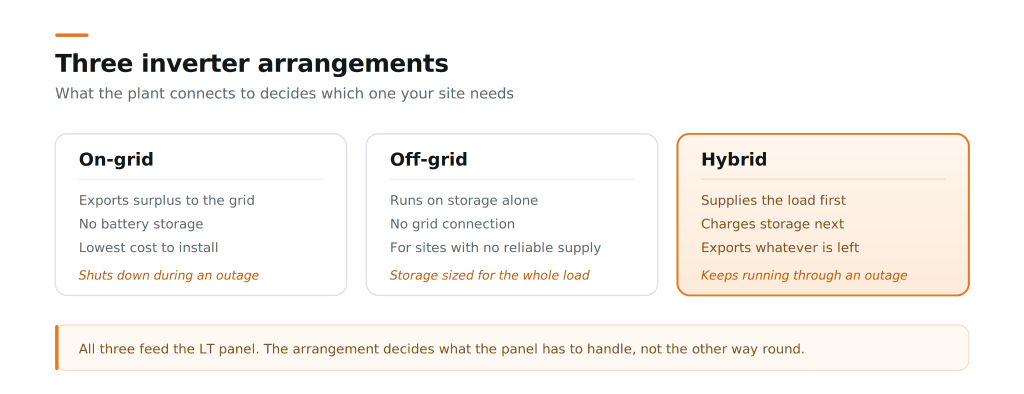
On-grid exports surplus and carries no storage. Simplest to connect, but it shuts down during an outage for safety.
Off-grid runs on storage alone, for sites with no reliable supply to connect to.
Hybrid supplies the load first, charges storage next, and exports the rest. It keeps running through an outage, which suits sites that cannot stop. Where storage is part of the plan, our piece on the future of battery energy storage covers where the technology is heading.
Inverters also differ in how they connect to the array. A string inverter takes a row of panels into one unit and is the common choice in India. A microinverter sits under each panel, so shade on one does not drag down the rest, at a higher cost.
GP Eco distributes INVERGY inverters and storage, manufactured INVERGY, alongside its own panel range.
What should you check before ordering?
For the panel
- Ask for design verification against IS/IEC 61439, not a general claim of compliance. If a quotation cites IS 8623, that standard has been withdrawn, so ask when the drawings were last reviewed.
- Check the short-circuit withstand rating against the fault level at your incoming supply. A panel rated below it is a hazard, not a saving.
- Confirm the ingress protection rating suits the location. An indoor plant room and an outdoor yard are different specifications.
- Check the form of internal separation, which decides whether a technician can work on one section while the rest stays live.
- Confirm bidirectional capability where solar feeds in, including metering and protection in both directions.
For the inverter
- Check the rating against the array, not the roof area. Undersized loses output on bright days; oversized is capacity you never use.
- Confirm it can synchronise with anything else running on site, particularly a generator.
- Check the BIS registration number covers the exact model quoted, not a sibling in the same family.
For both
- Send one single-line diagram to every supplier. Most trouble traces to equipment ordered against a one-line description instead of a specification. Two quotations on the same nameplate rating then turn out to be different products.
- Decide how you will see it running. SCADA and monitoring is easier to specify with the panel than to retrofit afterwards.
Where you buy shapes how much of this you manage yourself. Our guide to choosing a solar supply partner covers what a good supplier should produce on request. For the supply chain behind them, see solar distributorship in India.
Working with GP Eco Solutions
The question worth asking early is what the join between your equipment and your supply has to handle, in both directions, on the worst day. Answer that and price comparisons start to mean something.
GP Eco Solutions offers HT and LT electrical panels under the In NVERGY Electric brand, designed and developed for industrial, commercial and utility-scale use. On the LT side, the range covers PCC, MCC, APFC and synchronisation panels, alongside HT systems for utility, industrial and renewable energy sites.
They sit with theSCADA and monitoring systems and the INVERGY inverters and storage we distribute. You can see the range of work they go into on ourprojects page.
Send us your single-line diagram and your connected load, and our team can help you work out the right fit. Or talk to us about a project you are specifying now.
Frequently asked questions
Do I need a special LT panel for solar?
Not always a different product, but a different specification. The panel has to handle power flowing in two directions, and protection and metering have to account for that.
Where does the solar inverter connect on a rooftop plant?
On the load side of the transformer, feeding into the LT panel. That is why transformer rating and sanctioned load both limit how much solar a site can take.
Does solar affect my APFC panel?
It can. The inverter supplies real power while reactive demand carries on unchanged, so a correction scheme set before solar may need reviewing afterwards.
Can solar run alongside a diesel generator?
Yes, with a synchronisation panel and inverter settings that allow it. Without that, many sites disconnect solar whenever the generator runs.
Which standard applies to an LT panel?
IS/IEC 61439 covers LT assemblies up to 1,000 V. HT switchgear is built to IS 3427 and IEC 62271-200, covering above 1 kV up to 52 kV.
Do I need an HT panel as well?
Only if your supply arrives at high voltage. If it arrives at 415 V, the distribution company’s transformer sits outside your premises, and you need only an LT panel.