

India’s approved-list rules for solar equipment are moving further up the supply chain. The Ministry of New and Renewable Energy (MNRE) has announced plans to bring solar ingots and wafers under ALMM List-III, with the new requirements set to take effect from 1 June 2028.
Until now, the Approved List of Models and Manufacturers (ALMM) covered Solar modules and cells. ALMM listing is also important because projects covered under the relevant government schemes and rules may need to use approved modules to qualify for applicable subsidies or incentives.
ALMM is an MNRE-approved register of solar PV models and manufacturers whose products are eligible for use in projects covered under the ALMM Order, 2019.
Ingots and wafers, which MNRE describes as heavily import-dependent, have now been added. Once List-III comes into effect, module manufacturers will also need to ensure that the cells and wafers used in their modules are ALMM-listed.
What is ALMM and why does it matter?
The Approved List of Models and Manufacturers (ALMM) is a framework introduced by the Ministry of New and Renewable Energy (MNRE) to identify solar PV models and manufacturers eligible to supply equipment for projects covered under the ALMM Order, 2019.
This framework helps maintain quality standards and supports the use of approved solar equipment in India’s renewable energy projects. It also plays an important role in government-backed solar programmes, where using ALMM-listed modules is a requirement for eligibility under applicable schemes and incentives.
Now the big question is how this helps a manufacturer, and the answer is: for manufacturers, getting listed means their products can be supplied to projects where ALMM requirements are mandatory. For developers and EPC companies, it means checking whether the modules and other applicable components meet the relevant ALMM requirements before procurement.
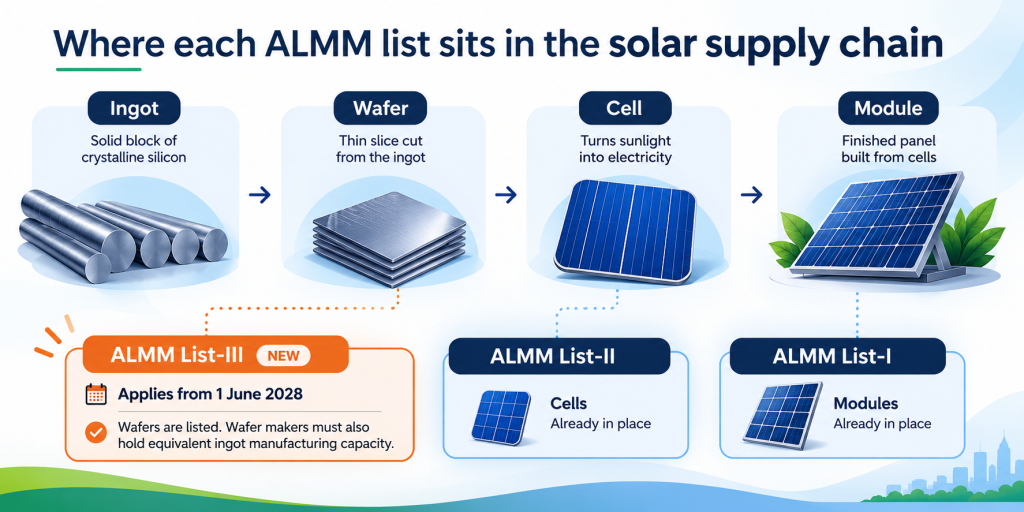
Until now, ALMM Listing covered solar modules and cells. With the introduction of List-III, MNRE is extending the approved-list requirement further upstream to solar wafers.
What’s the big announcement from MNRE for ALMM?
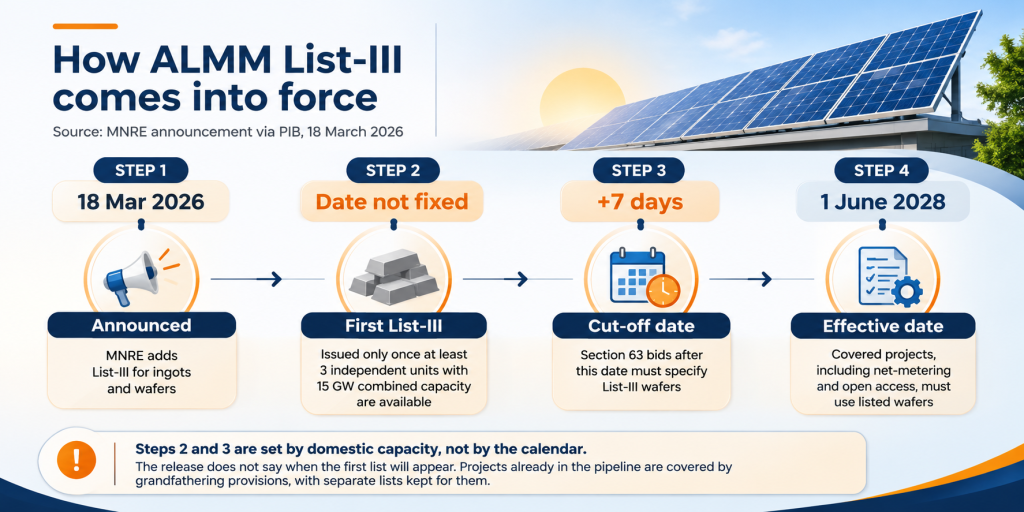
In a Press Information Bureau (PIB) release dated 18 March 2026, MNRE announced the introduction of ALMM List-III for solar wafers, extending the approved-list framework to another stage of solar manufacturing.
The announcement brings solar ingots and wafers into the framework, with the objective of strengthening domestic manufacturing and reducing dependence on imports for these critical raw materials.
Under the ALMM Order, 2019, the approved-list requirements apply to specified categories of solar projects. These include projects bid under Section 63 of the Electricity Act, 2003, through the competitive bidding route, as well as applicable net-metering and open-access projects.
The new List-III requirements will determine which wafers can be used in these covered projects and how module manufacturers must source their cells and wafers.
What do ALMM List-I and List-II cover?
The ALMM framework was initially introduced for solar PV modules and later extended to solar cells through two separate lists:
- ALMM List-I: Covers approved solar PV modules and their manufacturers. It identifies the module models eligible for use in projects covered under the ALMM Order.
- ALMM List-II: Covers approved solar PV cells and their manufacturers, extending the approved-list framework to the cells used in solar modules.
With List-I covering modules and List-II covering cells, the introduction of List-III takes the framework one step further upstream by bringing solar wafers and ingots into the picture.
The two dates that matter
- Effective date: 1 June 2028. From this date, covered projects, including net-metering and open-access projects, must use ALMM-listed wafers.
- Cut-off date: seven days after the first List-III is published. After this cut-off date, companies bidding for solar projects through competitive bidding under Section 63 must plan to use ALMM-listed wafers.
The release gives no calendar date for the cut-off, since it depends on when the first wafer list is issued.
When will the first ALMM List-III list be issued?
Only once enough domestic supply exists. MNRE has set two conditions:
- At least three independent manufacturing units, not under common ownership or control, with a combined capacity of 15 GW.
- Any wafer manufacturer seeking enlistment must also have equivalent ingot manufacturing capacity.
This is why the list is named for both. Wafers are what get listed, but a company that only slices bought-in ingots cannot enlist on wafer capacity alone.
What changes for the industry?
Module and cell manufacturers
From the effective date, List-I will include only modules made using ALMM-listed cells and wafers. A module maker’s listing will then depend on where its cells and wafers come from, as well as on its own plant.
Ingot and wafer manufacturers
MNRE says the ingot condition is meant to promote upstream integration, with expected benefits including new ingot and wafer investment, supply-chain security and traceability from wafer to module.
Developers and EPC companies
Section 63 bidders need to track the publication of the first List-III, since the seven-day cut-off runs from it. Net-metering and open-access projects face the wafer requirement from 1 June 2028.
MNRE says suitable grandfathering provisions protect projects already in the pipeline, and separate lists will be kept for those projects. The release does not set out which projects qualify, so the full order is the document to check.
Suppliers and distributors
With separate lists for grandfathered projects, the right module will depend on which list governs the project.
Our guide to how the solar supply chain works in India explains how approved lists shape what can be supplied.
Schemes with domestic content rules
The order does not dilute or override Domestic Content Requirement (DCR) provisions under existing MNRE schemes. DCR is a separate, scheme-level rule, and our explainer on ALMM List-II and how it differs from DCR covers the distinction.
Where does domestic capacity stand?
The release gives two markers. ALMM List-I grew from 8.2 GW in 2021 to around 172 GW at the time of the announcement, and List-II reached 27 GW within seven months.
What to watch next
1 June 2028 is the headline date. For Section 63 bidders, though, the first List-III may matter sooner, because its publication starts the seven-day cut-off. The full order will also clarify how projects already in the pipeline are treated under the new requirements.
For GP Eco Solutions and other solar EPC companies, these changes make early procurement planning increasingly important. Companies should coordinate with module suppliers, verify the ALMM status of cells and wafers used in selected modules, and align sourcing decisions with upcoming project timelines. Tracking MNRE notifications and updates to the approved lists will also help companies prepare for the transition.
For guidance on planning upcoming solar projects in line with evolving ALMM requirements, connect with the team at GP Eco Solutions.