
Solar equipment doesn’t move through India in a straight line. A module may start as imported raw material, pass through several manufacturing stages, move between suppliers and warehouses, and eventually reach an installation site. An inverter follows its own manufacturing and distribution route. Structures, electrical equipment, and other balance-of-system components have separate supply networks.
By the time a solar project is ready to be installed, several different supply chains have already met at the same site.
That is what makes the solar supply chain in India worth looking at beyond module manufacturing. Where products are made, where they come from, how they move, and who holds them before installation can all affect project cost and delivery time.
The main challenges become clearer when we examine manufacturing, component sourcing, and distribution.
What a solar supply chain actually is
A supply chain is every step between raw material and a working system, including the steps that only move things instead of making them.
For crystalline-silicon solar modules, the manufacturing process runs through five main stages. Silicon is purified into polysilicon, a high-grade feedstock that looks a bit like grey gravel. That gets melted and cast into ingots, solid blocks of silicon.
Ingots are sliced into wafers, thin square sheets. Wafers are treated to become cells, the parts that actually turn sunlight into electricity. Cells are then wired together, sealed behind glass, and framed to become modules, commonly called solar panels.
The first three stages are usually called upstream, the last two downstream. Upstream is capital-heavy and power-hungry. Downstream is closer to assembly, which is why it is easier to build and why most countries build it first.
Beyond module manufacturing, delivering a complete solar project also depends on three important stages: equipment sourcing, distribution, and installation.
Every system also needs the equipment that is not a panel. Inverters, electrical panels, cable, mounting structure, glass, junction boxes, and earthing. The trade calls this group the balance of system, often shortened to BoS.
The goods then have to be held somewhere, combined into a usable set, and sent out, which is distribution. After that, they have to arrive at a site and be installed.
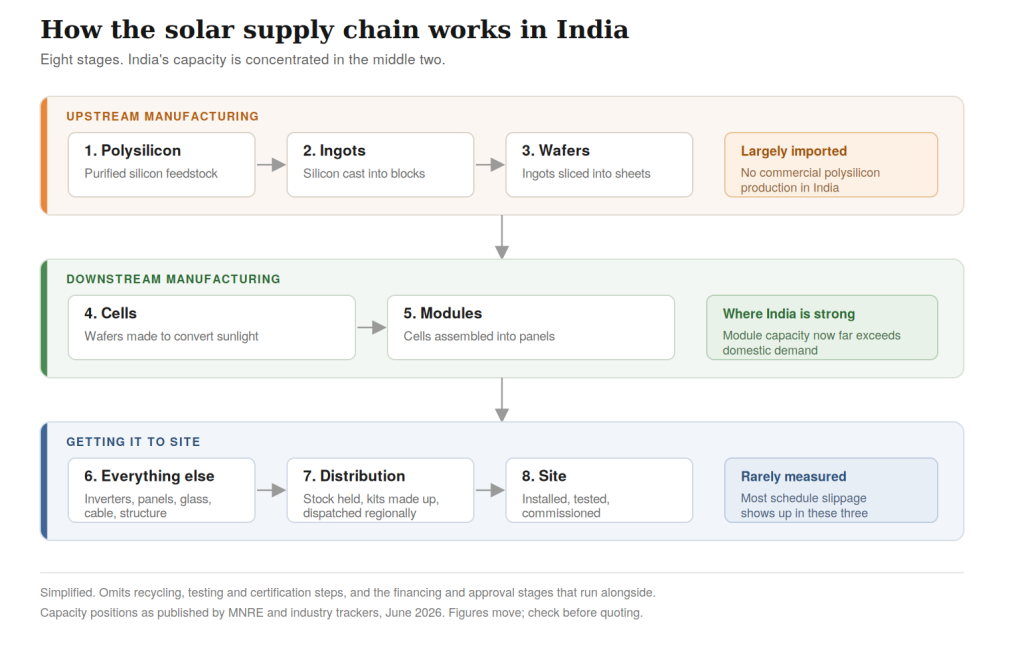
The first five stages decide what a component costs. The last three usually decide whether your project runs on time.
Where India Makes Solar Equipment
India’s position is not uniform across those stages, and the difference is large enough to change how you buy.
According to Mercom India Research’s State of Solar PV Manufacturing in India 1H 2026 report, India’s cumulative solar module manufacturing capacity stood at 261.7 GW, with cell manufacturing capacity at 36.6 GW. In the first half of 2026 alone, the country added 50.6 GW of module capacity and 9.7 GW of cell capacity.
Set that against annual domestic demand, which sits in the region of 50 to 55 GW depending on how fast deployment runs in a given year. Module capacity is several times what the country can absorb. Cell manufacturing capacity remains below the stated domestic demand estimate. Polysilicon has no commercial production in India, leaving the country heavily dependent on imports for upstream materials.
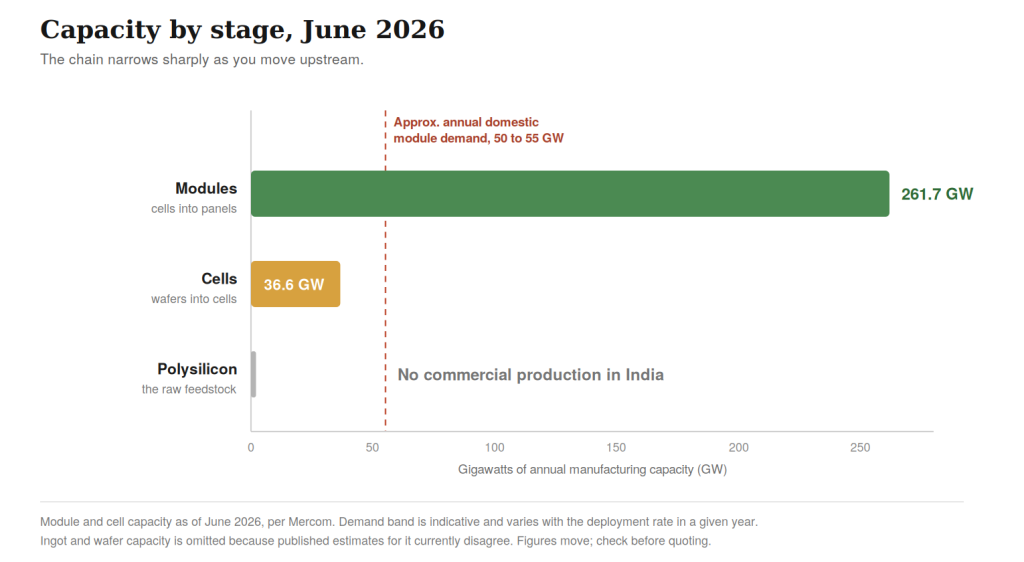
Ingot and wafer capacity is left off this chart deliberately. Published estimates for it currently disagree with each other by a wide margin.
What that shape means in practice is worth being precise about. A module manufactured in India may use domestically manufactured or imported cells. Domestic module manufacturing does not establish the origin of its cells or wafers. The cells inside it may or may not be Indian, and the wafers inside those cells almost certainly are not. The claim is accurate, and it is narrower than it sounds.
For a buyer, this is the difference between a module that qualifies for a scheme and one that does not. It is worth knowing which stage a supplier’s local-content claim refers to before you rely on it.
The rules that decide which panel you can use
Two policy dates sit on top of this, and both change what you are allowed to buy rather than what is available.
From June 2026, projects under government and subsidy-linked programmes must use domestically manufactured solar cells, not only domestically assembled modules. This moved the local-content requirement one stage upstream. A module built from imported cells was acceptable for these projects before that date and is not acceptable now.
A further step has been proposed for June 2028, extending similar domestic manufacturing requirements to ingots and wafers.
Think of it like baking a cake. Earlier, a solar panel could qualify as Made in India if it was assembled locally, even when its cells came from another country. Since June 2026, eligible government and subsidy-linked projects must use both domestically manufactured modules and solar cells. The proposed 2028 change would take this requirement further, bringing wafers and ingots into the domestic sourcing framework too.
In this analogy, the module is the finished cake, the solar cells are its key ingredients, and the wafers are the raw material used to make those ingredients.
Separately, the Approved List of Models and Manufacturers governs which products can be used in these projects at all. List-I covers modules and List-II covers cells.
If you are supplying into a scheme-linked project, the model you quote has to be on the right list on the day you supply it. These lists can change, and for that our guide to what ALMM List-II means for solar buyers goes into this.
The practical consequence is a split market. The same warehouse may hold two grades of apparently similar panels, one usable for a subsidised rooftop and one not, at different prices. Quoting the wrong one is an expensive mistake to find late.
The part of the chain that gets left out
Here is where most coverage of this subject stops, and where the interesting problem starts.
A finished module is roughly half of what arrives at a site. The rest is balance of system, and the domestic position there is uneven in a way the headline manufacturing numbers hide.
Some BoS segments have localised well. Domestic junction box capacity has reached a scale of roughly 120 to 150 GW. That is a clear shift from imports toward local supply, and it buys shorter lead times and local service.
India produces around 12 GW of solar glass a year against demand already above 25 GW. Encapsulants, backsheets and some mounting components remain partly imported. These are low-value items next to a module, and they stop a line just as effectively when they are missing.
The equipment that takes generated power and distributes it safely sits in LT and HT panels, and getting that specification right affects both safety approval and commissioning. If you are sizing that part of the system, the difference between HT and LT panels is the place to start. Inverters and storage are a parallel chain with their own manufacturers, lead times, and warranty terms, and firms such as Invergy build those units domestically.
Translating that: your schedule is not set by the longest-lead headline item. It is set by whichever line on the bill of materials arrives last. A project held up by a missing consignment of clamps is delayed exactly as much as one held up by a missing inverter.
Distribution, the layer between a factory and a roof
Between a manufacturer and an installation sits a stage that almost nobody describes. Distribution manages inventory, coordination, and delivery risks between manufacturers and installation sites. Manufacturers may use distributors or project-specific fulfilment arrangements to coordinate orders containing components from multiple suppliers.
Factories produce in long runs against forecasts. Sites consume in small, mixed, dated sets. A rooftop job needs a specific panel count, one inverter, a particular structure, a length of cable and the right protection equipment, at one address, on one morning. No factory is organised to do that.
Distribution is the layer that converts one pattern into the other. It holds stock close to demand, combines items from several manufacturers into a set a crew can actually install, and dispatches it against a date. Where that works, an installer sees one delivery. Where it does not, they see five part-deliveries and a rescheduled crew.
This is where GP Eco Solutions fits into the chain, bringing products, inventory, and technical support together through a pan-India distribution network.
This matters more as deployment spreads. The next wave of installations is coming from tier-2 and tier-3 towns, where distribution networks for high-value, fragile, multi-component goods are thinner than in metros. Serving a customer near a warehouse is one problem. Serving thousands scattered across small-town India is a different one, and more trucks do not solve it.
There is a quality dimension too that is easy to miss. Modules moved badly over rough roads can develop microcracks, which are fractures in the cell that do not show up on a visual check at delivery. They reduce generation quietly, over years. A system that underperforms its estimate three years in rarely gets traced back to how it travelled.
The scale of this is now visible in policy. Under the PM Surya Ghar scheme, more than 50 lakh households have had rooftop systems installed, with roughly 14.8 GW commissioned. Registrations have passed 1.38 crore, against a target of one crore installations by March 2027. When a Parliamentary Standing Committee reviewed the scheme, it identified logistical bottlenecks among the main challenges to scaling up.
Demand is not the constraint. Nor is manufacturing, at 261.7 GW of module capacity, a constraint. The constraint is the last three stages of the chain.
What to check before you commit to a supplier
Most of the above turns into a short set of questions. Choosing who you buy from is covered in more depth in our guide on what installers should check before buying from a supply partner. These are the supply chain-specific ones.
- Which stage does the local-content claim cover? Assembled in India, cells made in India, and wafers made in India are three different claims with three different consequences for scheme eligibility.
- Is the exact model on the current ALMM list? Not the brand; the model, on the day of supply.
- Is the order quoted as a complete set or as line items? A quotation that covers panels and inverters but leaves structure and cable to be arranged separately has moved the integration risk onto you.
- What is the lead time on the slowest item, not the headline one? Ask specifically about glass-dependent items, structure, and protection equipment.
- Where is the stock held? Distance from the holding point to your site is a better predictor of delivery reliability than any stated lead time.
- Who owns transit damage, and what is the inspection window? Microcracks will not be visible at delivery, so the answer matters.
- For larger plants, how will generation be monitored? Underperformance is only recoverable if it is detected, which is what SCADA monitoring is for.
A supplier who answers these quickly is telling you something about how their own chain is organised.
What’s Changing Next in India’s Solar Supply Chain
Two shifts are worth watching.
The first is upstream manufacturing. In March 2026, the Ministry of New and Renewable Energy (MNRE) expanded the Approved List of Models and Manufacturers (ALMM) framework to include solar ingots and wafers. Under the expanded framework, ALMM List-III will cover wafers, with the requirement taking effect from 1 June 2028. The notification also includes transitional and grandfathering provisions to protect projects already in the pipeline.
This moves domestic sourcing requirements further upstream, beyond modules and cells. Manufacturers seeking inclusion in ALMM List-III for wafers must also have equivalent ingot manufacturing capacity. For India, where upstream solar manufacturing remains heavily dependent on imports, this creates another push to build domestic production capacity.
The second is downstream, and less discussed. As module supply stops being scarce, competition between suppliers moves to delivery, completeness, and service. That is harder to build than a module line, and slower to copy.
Storage adds a third thread. Battery storage is becoming relevant to more commercial projects, depending on tariffs, backup requirements and project economics. We look at where storage is heading in our note on the future of battery energy storage systems.
What This Means When You Buy Solar Equipment
India’s solar supply chain is strongest in module manufacturing, but the pressure is shifting to upstream materials, balance-of-system equipment, and delivery. When buying, ask for the full bill of materials and a lead time for every item, not just the panels.
GP Eco Solutions works with installers, EPC companies, and businesses, supplying solar products through a pan-India distribution network. That is backed by inventory management, partnerships with global and domestic brands, and technical support covering fit for your project, system compatibility, and after-sales. For project delivery on larger plants, GPES Green Projects handles turnkey EPC, PMC, and Energy-as-a-Service work.
Have a bill of materials you want looked at before you place an order? Talk to our team, and we can walk you through what a supply plan for your project would need to cover.
Frequently asked questions
What are the stages of the solar supply chain in India?
Manufacturing runs through polysilicon, ingots, wafers, cells, and modules. Beyond that, a working system needs balance of system equipment such as inverters, panels, cables, and structures. It then needs distribution to hold and dispatch it, and installation at the site.
Does India manufacture its own solar panels?
India assembles modules at very large scale, with cumulative module capacity of 261.7 GW as of June 2026. Cell capacity is far smaller at 36.6 GW, and there is no commercial polysilicon production in India, so upstream material is still largely imported.
What does domestically manufactured mean for solar cells?
Since June 2026, projects under government and subsidy-linked programmes must use cells that were themselves made in India, not only modules assembled in India from imported cells. It is a requirement at a specific stage of the chain.
What is balance of system in solar?
Everything in an installation other than the modules. Inverters, electrical panels, mounting structure, cable, earthing, junction boxes, and protection equipment. It is often half the delivered content of a project and a common source of delay.
Why do solar projects get delayed if panels are available?
Because a project needs every item, not just the main one. A missing structure component or a cable consignment stops installation as completely as a missing panel. Delay usually traces to the last item to arrive rather than the largest.
What is ALMM and why does it matter to buyers?
The Approved List of Models and Manufacturers sets out which solar models can be used in government and subsidy-linked projects. List-I covers modules and List-II covers cells. A model has to be listed at the time of supply, and the lists are revised.