

A solar panel can be approved and still be the wrong panel for a project.
That is the procurement question ALMM List-II has changed. The check no longer stops at the module’s model number or manufacturer; for covered projects, what sits inside the module now matters too.
For developers and procurement teams, the real challenge is knowing which requirements apply before placing the order. That makes ALMM List-II less of a paperwork check and more of a project-planning decision.
So, in this blog, we’ll explain ALMM List-II, when it applies, the key dates buyers need to know, and what to check before buying solar modules.
What ALMM List-II actually is
ALMM stands for the Approved List of Models and Manufacturers. It is the register maintained by the Ministry of New and Renewable Energy of equipment that may be used on certain solar projects in India.
It has always been designed as two lists. List-I names approved solar photovoltaic modules, the finished panels. List-II names approved solar photovoltaic cells, the parts inside the panel that convert sunlight into electricity.
The two lists are linked, not parallel. For a project covered by ALMM, the module has to come from List-I, and the cells inside that module have to come from a manufacturer on List-II. Meeting one condition without the other is not compliance.
List-I has been in operation since the first module list was issued on 10 March 2021. The first list for cells was published on 31 July 2025 and has been revised repeatedly since.
For buyers who have relied on a single check for five years, the consequence is uncomfortable. A module can sit on List-I and still be wrong for your project. The question has moved from the label on the panel to the cell behind it.
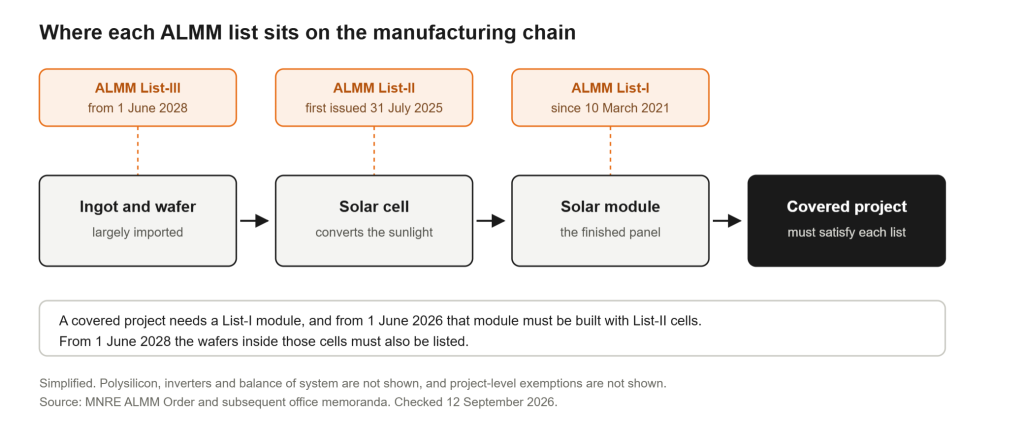
Each list sits one step further up the manufacturing chain than the one before it. A covered project needs compliance at every step already in force.
Why a separate list for cells was introduced
The ALMM Order issued in January 2019 provided for both lists from the start. List-II was then not issued for six years. The Ministry’s own reason is the clearest account of the timeline. Its office memorandum of 9 December 2024 records that the list was held back because installed solar cell capacity in the country was lower than demand.
That gap had a visible effect on the market. Modules could be assembled in India from imported cells, and the assembled module still qualified for List-I. The list was doing its job on the finished product while much of the value inside it was made elsewhere.
Domestic capacity then moved quickly. According to the Ministry’s own statement of March 2026, ALMM List-I grew from 8.2 GW in 2021 to around 172 GW. List-II reached 27 GW within seven months of first being published.
Two things follow for anyone planning procurement. Supply is no longer theoretical, so the case for further delay is weaker than it was. And because each step has been tied to capacity instead of to a calendar, these dates have moved before, and they are argued over each time one approaches.
Which projects ALMM covers, and which it does not
ALMM does not apply to every solar plant built in India. It applies to a defined set, and reading that set correctly is the first thing to get right.
The ALMM Order covers government projects, government-assisted projects, projects under government schemes and programmes, open access projects and net metering projects. It also covers projects set up to sell electricity to the government under the Electricity Act, 2003. “Government” is defined broadly, taking in the Centre, state governments, central and state public sector enterprises, and central and state organisations and autonomous bodies.
Two edges of that boundary are worth stating plainly, because both are commonly reported the wrong way round.
A project under a state government or union territory scheme is covered even where it takes no financial assistance from the Central Government. The Ministry has confirmed this directly in its published questions and answers on the cell mandate.
A genuinely private plant is a different matter. A captive installation with no net metering, no open access, no scheme participation, and no sale to a government entity does not fall under ALMM. Claims that every panel installed in India must now carry List-II cells are wrong, and buyers acting on them are narrowing their options for no reason.
The first procurement question, then, is not which module to buy. It is which category the project sits in.
ALMM List-II: Key Dates for Bidding, Net Metering and Open Access
This is where most of the confusion comes from. Coverage of the subject almost always reduces the cell mandate to a single date, 1 June 2026. There are two clocks. They run on different project routes, and they measure different events.
For projects awarded through bidding, the governing event is the last date of bid submission. The cut-off is 31 August 2025, set as one month after the first cell list was published. If bid submission fell on or before that date, the project must still use List-I modules but is exempt from the cell requirement. It stays exempt however late it commissions. If bid submission fell after it, List-II applies, even where the project was commissioned before 1 June 2026.
For net metering and open access projects, the governing event is commissioning. The original effective date was 1 June 2026. An office memorandum dated 18 July 2026 then provided a limited window: these two categories can commission with exemption from ALMM List-II until 31 December 2026. Projects in these categories commissioning from 1 January 2027 have to source cells from List-II.
The Ministry was explicit that this is not a blanket extension and that its policy on implementing List-II is unchanged. The window covers two project categories and the cell requirement only. List-I compliance is untouched throughout.
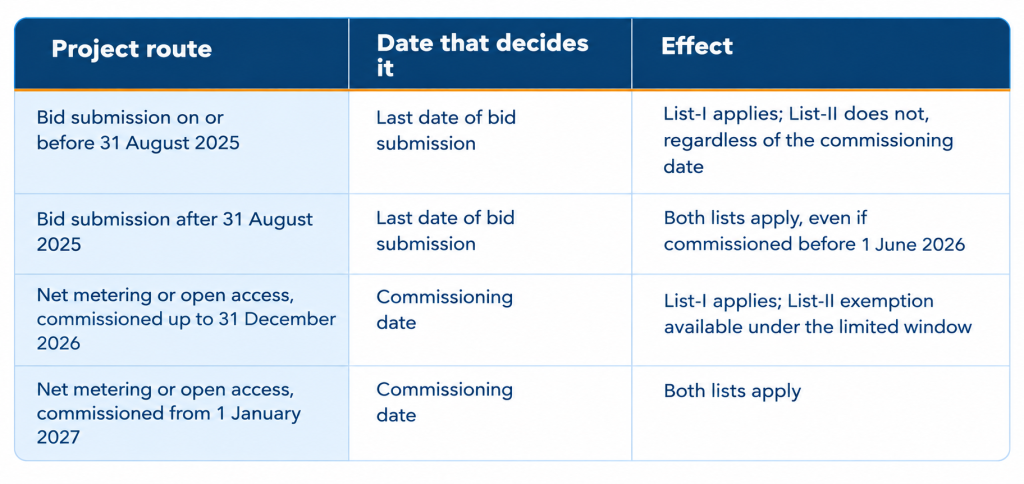
The translation is short. If you are bidding, the date that governs your obligation has already passed and is fixed in the tender record. If you hold a net metering or open access project, the date that matters is the commissioning date, not the order date or the delivery date.
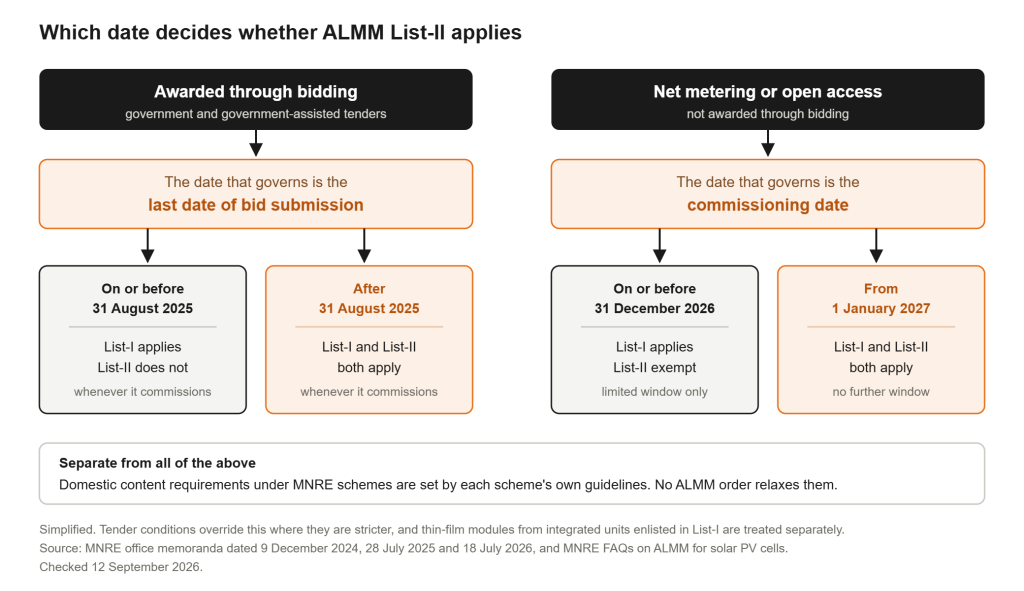
Simplified. It shows the two main routes and omits project-specific tender conditions, which override the general position where they are stricter.
ALMM List-II vs. Domestic Content Requirements: What’s the Difference?
This is the second point regularly reported incorrectly, and the more expensive of the two to get wrong.
Several central schemes carry domestic content requirements, under which both the cells and the modules must be manufactured in India. These apply to the CPSU Scheme Phase-II, to Components B and C of PM-KUSUM, and to PM Surya Ghar: Muft Bijli Yojana.
Those requirements are governed by the guidelines of each scheme, not by the ALMM orders. The Ministry has stated that no ALMM order relaxes any domestic content provision in its schemes, and it repeated the point when extending the framework to wafers.
So the December 2026 window is a window in the ALMM cell requirement. It is not a window in scheme eligibility. A rooftop project claiming a subsidy under a scheme with a domestic content condition still has to meet that condition on the scheme’s own terms.
One detail is worth carrying into any PM-KUSUM discussion. Under Component C, the relaxation from using domestically manufactured cells remains valid where the Letter of Award was issued on or before 31 March 2024. Where the Letter of Award came later, the domestic cell and module requirement continues to apply, regardless of the bid submission date.
What this changes in procurement
“Is it ALMM approved?” has stopped being a useful question. It now has to be asked in two parts, and the answers come from different places.
- Check the module model, not the brand. Compare the exact model number on the quotation against the current List-I on the Ministry’s website. A different model number from the same manufacturer is a different listing.
- Ask where the cells come from. Where List-II compliance is needed, ask the supplier to confirm the cell manufacturing unit and its enlistment, and to put that on the order.
- Watch for the separate module list. The December 2024 order provides for a distinct list of modules that are enlisted under ALMM but do not use List-II cells. It is available only to projects exempt from the cell requirement. So “on ALMM” no longer tells you which projects a module can be used on.
- Treat the December window as a commissioning deadline, not a purchase deadline. Sanctions, metering, inspection and connection all sit between delivery and commissioning, and none of them move faster because a panel arrived early.
- Check what an addition to an existing plant triggers. As the Ministry’s FAQ sets out, a plant commissioned before the cut-off keeps its original List-I compliance, and that survives a transfer of ownership. Any addition to the commissioned capacity afterwards has to use List-II cells for the added capacity.
- Note the thin-film position. Thin-film modules on List-I that are made in integrated manufacturing units enlisted in List-I are treated as compliant with the cell requirement.
Most of this comes down to whether the supplier can answer with documents instead of assurances. That is the same test behind what an installer should check before committing to a supply partner.
What’s Next After ALMM List-II: Ingots and Wafers

The pattern set by the cell list is now being applied one step further up the chain.
An amendment dated 17 March 2026 extended the ALMM framework to solar ingots and wafers through a new List-III, effective from 1 June 2028. From that date, all covered projects, including net metering and open access projects, must use listed wafers. Manufacturers seeking enlistment for wafers must also hold equivalent ingot manufacturing capacity.
Two conditions shape when this actually bites. The initial wafer list will only be issued once at least three independent manufacturing units, not under common ownership, are running a combined 15 GW. For projects bid under the competitive bidding route, the cut-off is seven days after that initial list is published.
From the effective date, List-I will contain only modules made with listed cells and listed wafers. Separate lists will be maintained so that projects already in the pipeline are not disrupted.
If you are bidding work that commissions in 2028 or later, read the wafer clause into the tender and the supply contract while pricing is still being agreed.
Planning around the next deadline
The useful work here is not choosing a panel. It is establishing which category a project falls into, which date governs it, and whether the supply chain behind the quotation can be evidenced instead of asserted. Those three answers decide whether a project qualifies, and all three are available before an order is placed.
GP Eco Solutions works with installers, EPC companies, and businesses across India, supplying solar components and supporting the right fit for the project, system compatibility and after-sales requirements.
If you are planning a project that commissions in 2027 or later, share the project category and the target commissioning date with our team through the contact page.
We can talk through what the supply side of that timeline needs to look like.
Frequently asked questions
What is ALMM List-II?
ALMM List-II is the Ministry of New and Renewable Energy’s approved list of solar photovoltaic cell models and manufacturers. For projects covered by ALMM, modules must come from List-I and the cells inside them must come from a manufacturer enlisted in List-II. The first cell list was published on 31 July 2025.
Does ALMM List-II apply to every solar project in India?
No, it applies to projects covered by the ALMM Order. Those include government and government-assisted projects, projects under government schemes, net metering projects, open access projects, and projects selling electricity to the government. A private plant outside all of these categories is not covered.
Is the December 2026 relaxation available to my project?
Only if it is a net metering or open access project commissioned on or before 31 December 2026. The window does not extend to projects awarded through bidding, and it does not touch the module list.
Does the window also relax subsidy conditions?
No, Domestic content requirements under PM Surya Ghar: Muft Bijli Yojana, PM-KUSUM Components B and C, and the CPSU Scheme Phase-II are governed by those schemes’ own guidelines. No ALMM order relaxes them.
What happens to a net metering project that misses 31 December 2026?
From 1 January 2027, it has to use List-I modules built with List-II cells. Modules already bought that do not meet the cell condition can still be used on projects exempt from it. The exposure is usually a redeployment and schedule problem before it is a write-off.
Does adding capacity to an older plant trigger the cell requirement?
Yes, for the added capacity. A plant commissioned before the cut-off keeps its original compliance position, and that survives a change of ownership. Any addition to the commissioned capacity afterwards has to comply with List-II.
When do wafers come into the framework?
From 1 June 2028, subject to the initial wafer list being issued once at least three independent manufacturing units with a combined 15 GW of capacity are operating.