
The expensive failures at a solar plant are rarely the dramatic ones. A blown fuse announces itself. Somebody drives out to the site, and it is fixed by lunch.
The costly ones are quiet. One section of the array stops pulling its weight in February, and nobody notices until the annual review in October. The plant ran every day, and the app stayed green.
Eight months of a small invisible loss can cost more than any single breakdown that year.
Most plants in that position already have something they call monitoring. Usually it is a free app from the inverter company, sitting on somebody’s phone. Spotting a slow loss across ninety circuits, and saying which one, is a different job.
So what does a SCADA system actually do, and at what point does a plant need one?
What a SCADA system actually does
SCADA stands for Supervisory Control and Data Acquisition. The name is unhelpful, so take it in two halves.
Data acquisition is the collecting half. Sensors and meters across the plant send readings to one place, every few seconds, all day.
Supervisory control is the half people miss. The system can send instructions back to the equipment. An operator sitting in an office can reduce the plant’s output, hold power factor at a set value, or shut a section down.
That second half is the real difference. A monitoring app reports what happened yesterday. A SCADA system shows what is happening now and lets somebody act on it.
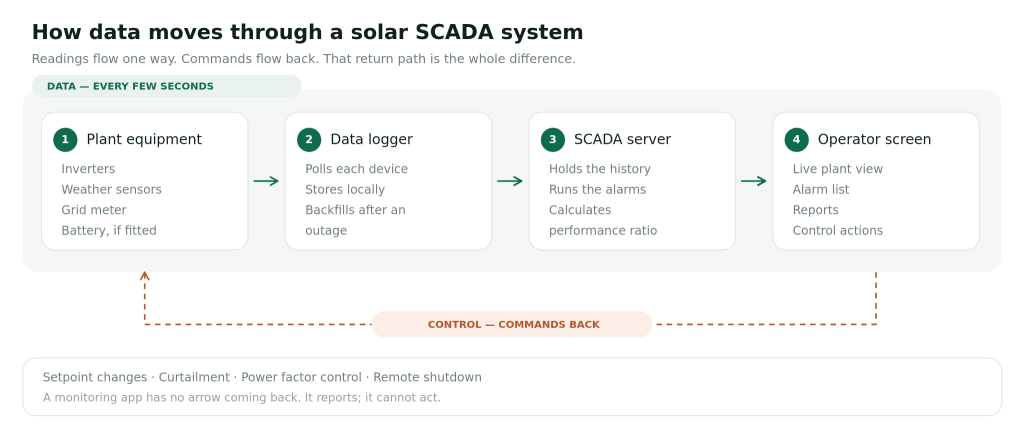
The return arrow is the part an app does not have.
How it differs from the free inverter app
This is the question most plant owners are really asking, so it is worth answering directly.
The free app reads one manufacturer’s inverters. If your plant has equipment from more than one company, the app cannot see across it, and nobody is looking at the plant as a whole.
| Free inverter app | SCADA system | |
| Equipment covered | That one brand | Everything on the plant |
| Sends commands | No, display only | Yes |
| Who holds the data | The inverter company | You |
| Mixed brands | No | Yes |
| Talks to the grid operator | No | Yes |
| Weather readings | Rarely | Standard |
For a small rooftop system, the app is genuinely enough. The gap opens as the plant grows, because losses that were worth a few hundred rupees a month start being worth a few lakh a year.
What it watches, and the part not to cut.
Four groups of readings, gathered together so they can be compared against each other.
- Generation. Output from every inverter, and on better systems from every string, meaning each row of panels wired as one circuit.
- Weather. Irradiance, which is how much sunlight is falling on the panels, plus module and ambient temperature and wind speed.
- The grid connection. Voltage, frequency, power factor, and the power flowing in and out.
- Storage. Charge level, state of health, and cell temperatures, where batteries are fitted.
The weather group is the one people cut from the budget first, and it is the one that makes everything else mean something. Without irradiance, a low reading could be cloud cover or a fault, and the data cannot tell you which.
With it, you can calculate the performance ratio, which compares what the plant produced against what the sunlight that day made possible. That single number is the honest way to judge whether a plant is doing its job.
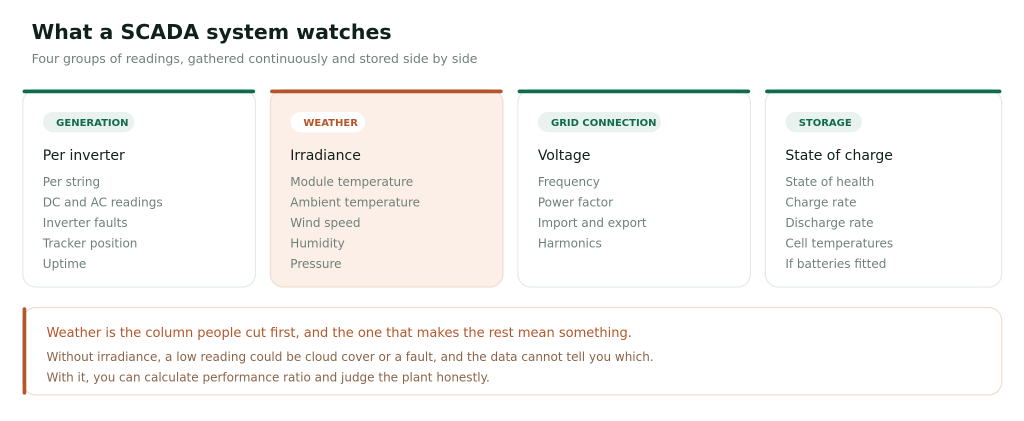
Four groups of readings, gathered continuously and stored together.
Where did SCADA come from?
SCADA grew up in water utilities, pipelines and power stations, decades before solar. Early systems served one site, one owner and usually one vendor.
Modbus arrived in 1979 and made mixed equipment possible. Nearly fifty years on, it is still what most inverters and meters on an Indian plant speak, which is why integration means mapping registers by hand.
IEC 61850 came later, built for substations and for talking to a grid operator. That is the one the new standards are named after.
Why monitoring is becoming a requirement in India
Here is the part most articles on this subject have not caught up with.
During 2026, the Central Electricity Authority notified the Technical Standards for Construction of Electrical Plants and Electric Lines (Amendment) Regulations, 2026. The new chapter runs in five parts, covering solar, floating solar, onshore wind, offshore wind and Battery energy storage system(BESS) . It comes into force on 1 April 2027.
Monitoring is written into it directly. Among the requirements:
- SCADA systems, power quality meters, harmonic analysers and event loggers for covered renewable and storage plants.
- Automatic Weather Stations (AWS) meeting World Meteorological Organisation (WMO) standards for renewable projects of 10 MW and above, measuring irradiance, wind speed, ambient temperature, humidity and pressure.
- Power plant controllers are able to receive dispatch instructions from Load Despatch Centres, with active and reactive power control. Load Despatch Centres are the bodies that tell plants how much to generate at a given moment.
- Secure and redundant communication to the grid interconnection point, with the link used for protection kept separate from the monitoring system.
- Inverters compliant with IEC 61850 communication, with fault recording and data held for at least 90 days.
Two things follow for anyone planning a plant. Above 10 MW, a weather station is no longer an optional line in the budget. And a system that only displays readings cannot meet the controller requirement, because it has no way to accept an instruction.
Two caveats, because this is recent. The thresholds above are the ones in the notification, and your state grid code or connection agreement may ask for more at a smaller capacity. The regulations also govern construction, so what binds you depends on when the plant is built and not on what you already own.
If you are designing a plant now for commissioning after April 2027, this is a decision being made today. Laying a communication backbone with the cable trays costs considerably less than retrofitting one into a finished plant.
Does your plant need one?
Not every plant does, and it is worth being straight about that.
- Rooftop systems below roughly 100 kW. The inverter app covers it, as long as somebody opens it monthly. That habit is where most of these actually fail.
- A few hundred kilowatts up to a few megawatts. This is where a proper system starts paying for itself, particularly where equipment came from more than one manufacturer.
- Plants of 10 MW and above, or any plant selling under a power purchase agreement. Close to unavoidable, between the new standards, deviation charges and performance guarantees.
- Any site where the plant supports critical operations. A hospital or a cold store needs to know about a problem before anyone downstream does.
What to ask before you buy one
Five questions, in the order that matters.
Will it read the equipment I already own? Ask which protocols it speaks, meaning the languages different machines use to talk to each other. Modbus RTU and Modbus TCP cover most inverters and meters, while IEC 61850 and IEC 60870-5-104 come up where you talk to the utility. Hand over your actual equipment list and ask for confirmation item by item, because “supports Modbus” and “we have tested it with your model” are different statements.
Where does the data live, and can I take it away? On your server, on rented hosting, or on the supplier’s cloud. All three can be defensible. Discovering in year three that five years of history cannot be exported is not.
Can it control, or only display? Ask for the specific commands. Setpoint changes, curtailment, power factor control, remote shutdown.
What happens when the link drops? A logger with local storage keeps recording through an outage and backfills when the connection returns. Without it, you get a hole in the record, and holes appear exactly when the record matters.
Who maintains it in year four? Sensors need recalibration, and software needs updating. Ask what that costs before signing rather than after.
Where this is heading
Regulators are asking for more visibility into renewable plants, not less, because a grid carrying a rising share of solar needs to know what that solar is doing.
Forecasting rules point the same way. The Central Electricity Regulatory Commission has set out a path that tightens how far a plant’s actual output may stray from its forecast. The tolerance for solar moves from ten per cent towards five per cent, over a period running to 2031, with charges applying beyond the band.
Monitoring is shifting from a way to check on a plant towards part of how a plant is allowed to operate.
Where this leaves you
If your plant is small, the free app and the habit of opening it will carry you a long way. If it is a large, mixed brand, or being built to run past April 2027, the useful next step is writing the monitoring specification before anyone quotes against it.
The first question on that list is the one you can settle today. Find out what your existing equipment can actually be read by, because that answer shapes every decision after it.
At GP Eco Solutions, we develop SCADA and energy management systems for solar, hybrid and utility-scale power assets. They cover real-time monitoring, alarm and fault detection, remote control, and historical trend analysis. They sit alongside the HT and LT panels they connect to and the Invergy inverters and storage we distribute.
Send us your equipment list and our team can walk you through what a system for your plant would need to cover.
Frequently asked questions
Is SCADA mandatory for solar plants in India?
For plants covered by the CEA’s 2026 amendment, monitoring requirements including SCADA, power quality meters and event loggers are written into the technical standards. They take effect from 1 April 2027, and automatic weather stations apply from 10 MW upward. State grid codes and connection agreements may add more, so check what your DISCOM specifies for your connection.
Does a rooftop solar plant need SCADA?
Usually not below around 100 kW, provided somebody reviews the inverter portal regularly. Above that, and especially where equipment comes from several manufacturers or the plant supports critical load, a proper system starts to earn its cost.
What does a solar SCADA system cost?
It depends far more on the plant than on the software. The price moves with the number of devices to be polled and how much new cabling the site needs. It also moves with whether string-level sensing and a weather station are included, and what ongoing support you want. Ask for hardware, software, installation and annual support to be quoted separately, because bundled quotations cannot be compared.
Does it need an internet connection?
The system runs on the local network at the plant, so it keeps working during an outage. The internet link is for remote viewing and for sending data onward to a load despatch centre.
Can one system handle equipment from different manufacturers?
That is the main reason to have one. It works through open protocols, most commonly Modbus, with IEC 61850 and IEC 60870-5-104 used for utility-facing communication. Give the supplier your equipment list and ask them to confirm each item.
Is a power plant controller the same thing?
No. A power plant controller does one job, regulating output at the connection point to follow grid instructions. SCADA is the wider system that gathers data from everything, raises alarms, and holds the history. Larger plants often run both.