
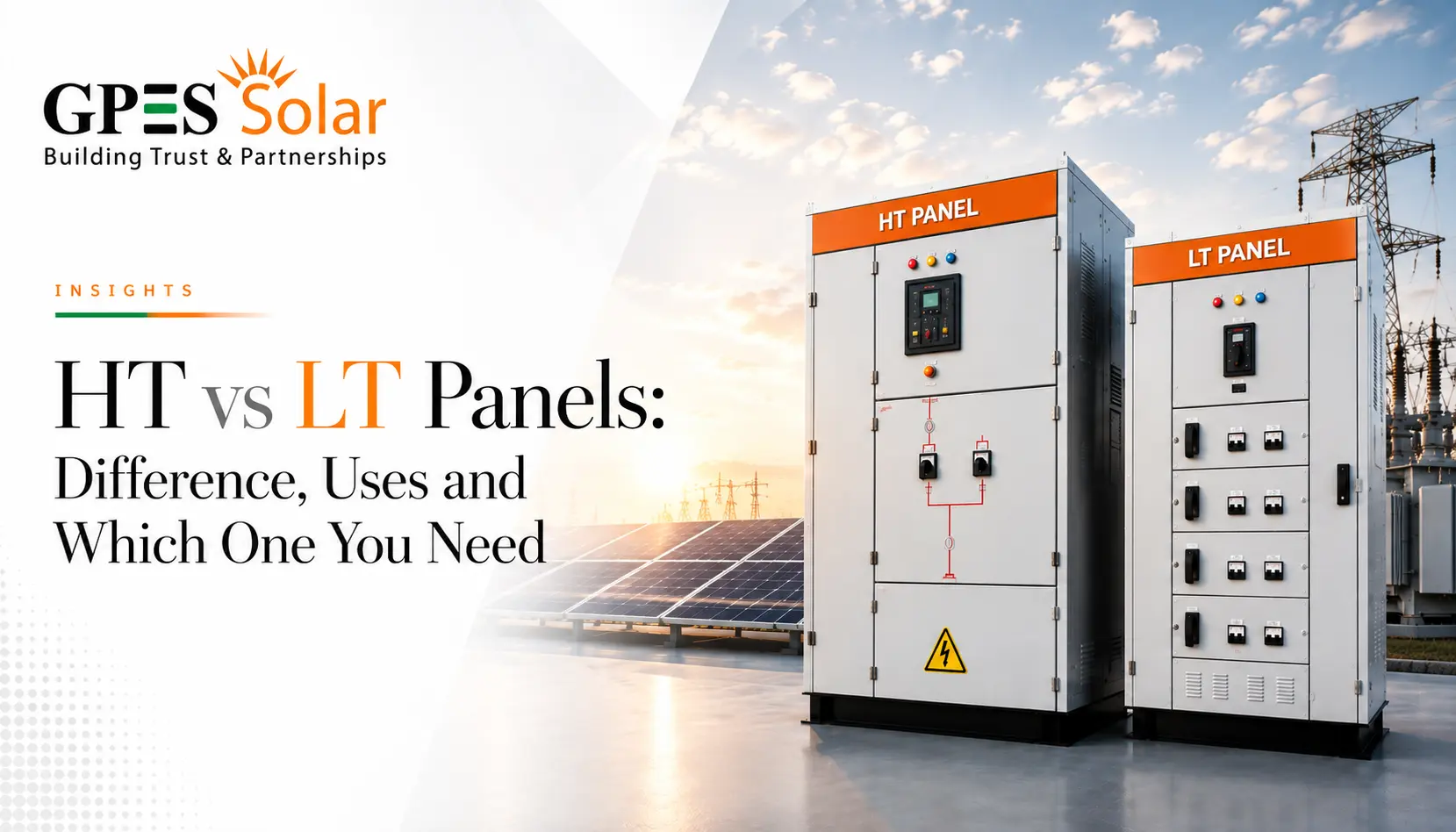
An HT panel and an LT panel do different jobs, and they sit at different points in your electricity supply.
Most factories, hospitals and large commercial buildings need both. A small workshop or shop needs only one. The whole thing is decided by how much power your site draws, and your electricity bill already tells you the answer.
This piece covers what each panel does, how to work out which your site needs, and what to check before you buy.
What is the difference between an HT and an LT panel?
HT stands for high tension and LT for low tension. Tension is an older word for voltage, borrowed from French, which stuck in Indian and British practice.
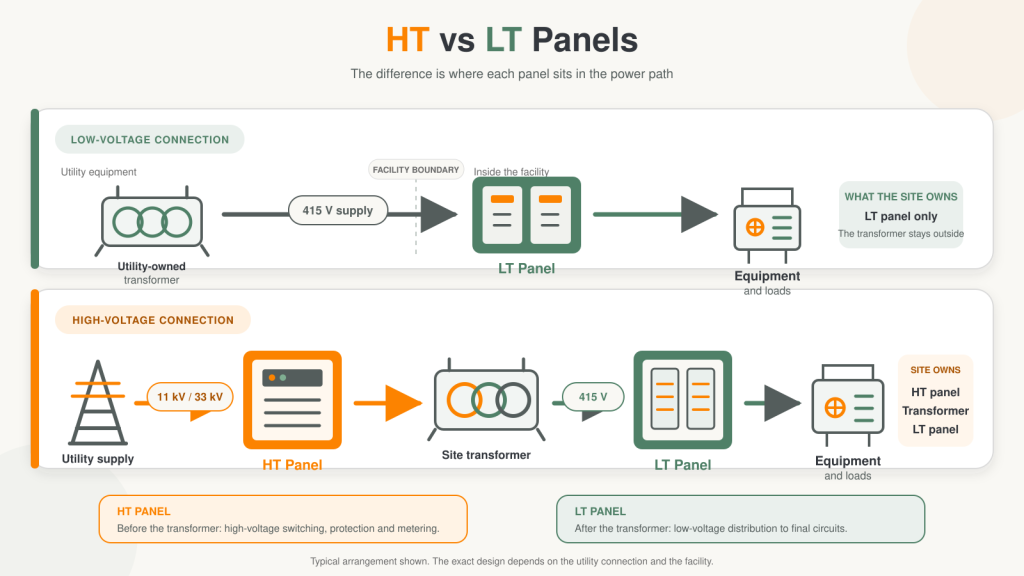
The simplest way to tell them apart is by where they sit relative to your transformer.
An HT panel comes first. It receives incoming supply at high voltage, then switches, protects and meters it before that supply reaches the transformer.
An LT panel comes after. It takes the low voltage coming out of the transformer, splits it into circuits, and protects each one on its way to your equipment.
So there are not two options on a shelf. They are two points on the same path, and where your supply joins that path decides how many of them you own.
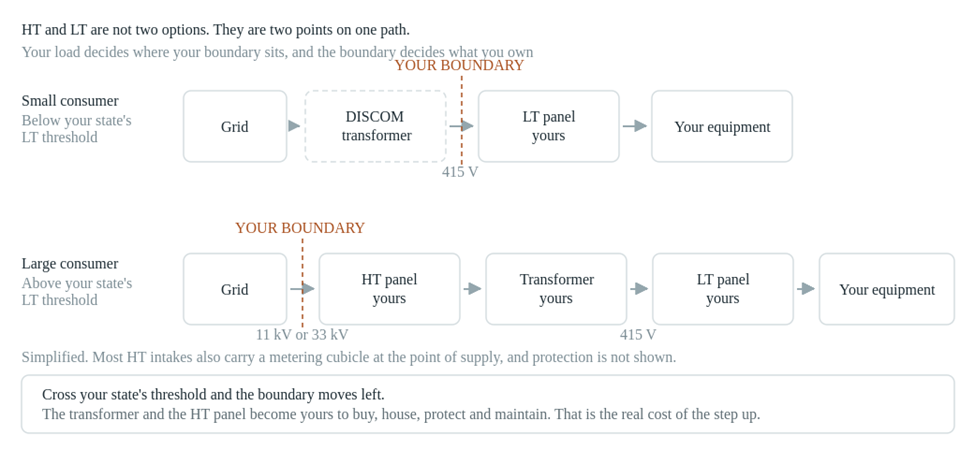
Where your supply joins the path decides what you own.
You will also see the same equipment called Medium Voltage (MV), in international documents. The 11 kV panel an Indian tender calls HT is what a European specification calls MV.
Which one does your site need?
Your distribution company decides this, and it decides on load, not on anything about the panel.
If your load is small, the DISCOM’s transformer stays outside your boundary. Supply arrives at your premises at 415 V, goes into your LT panel, and out to your equipment. You never buy an HT panel.
If your load crosses a threshold, the utility hands you power at 11 kV or 33 kV instead, and the transformer becomes yours. Now you need the full sequence: HT panel, transformer, LT panel.
That threshold is set by your state regulator, and it differs from state to state.
| State | Where the LT ceiling sits |
| Rajasthan | For industrial consumers, LT up to a connected load of 112 kW and contract demand of 50 kVA |
| Kerala | Maximum LT load of 100 kW, or 100 kVA where billing is demand based |
| Odisha | Contract demand below 70 kVA treated as LT for tariff purposes |
| State | Where the LT ceiling sits |
| Rajasthan | For industrial consumers, LT up to a connected load of 112 kW and contract demand of 50 kVA |
| Kerala | Maximum LT load of 100 kW, or 100 kVA where billing is demand-based |
| Odisha | Contract demand below 70 kVA treated as LT for tariff purposes |
Sources: Rajasthan, JVVNL Tariff for Supply of Electricity, Schedule MP/LT-6 Medium Industrial Service. Kerala, Electricity Supply Code, 2014, Regulation 8, as substituted by the Fifth Amendment Code, 2024. Odisha, OERC Distribution (Conditions of Supply) Code, 2019, Regulation 134(I). Figures checked August 2026. Thresholds are category specific and change with each tariff order.
Thresholds run from 50 kVA to 100 kVA and above, so there is no single national number to quote. The quickest way to find your answer is to look at your electricity bill, where the connection is already named LT or HT.
What voltage counts as HT, and what counts as LT?
If you have looked this up before, you may have come across different numbers. Some sources say 650 V and others say 1,000 V. Both are correct, because they come from different rulebooks written for different purposes.
It is worth knowing which one applies to your question.
For safety obligations, the line is 650 V. India’s electrical safety framework comes from the Central Electricity Authority regulations of 2023. Those regulations contain no table classifying voltages. They divide the rulebook itself, with Chapter V covering installations up to 650 V and Chapter VI covering those above it. Cross that line and different obligations apply, covering approvals, clearances, interlocking and testing.
The older figures people still quote, 250 V and 33 kV among them, come from the Indian Electricity Rules of 1956. Those rules no longer govern.
For buying a panel, the line is 1,000 V. LT assemblies are built and verified to IS/IEC 61439, which covers up to 1,000 V AC. HT switchgear is built to IS 3427 and IEC 62271-200, covering above 1 kV and up to 52 kV. That upper figure takes in all the 11 kV and 33 kV equipment Indian sites use. Above 1,000 V, you are buying a physically different product, with different type tests and clearances.
One detail worth carrying into your next tender. The older Indian standard IS 8623 has been withdrawn and superseded by IS/IEC 61439. Plenty of supplier literature still quotes it. If a quotation cites IS 8623, it is fair to ask when the drawings were last reviewed.
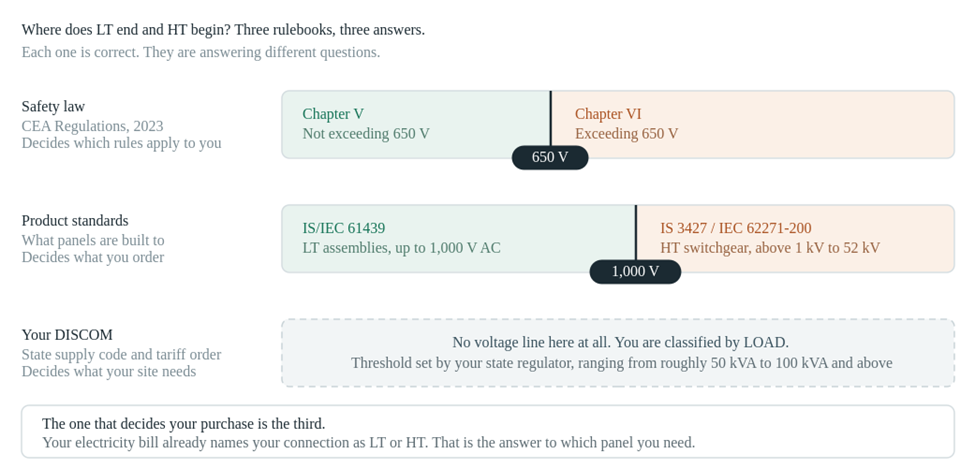
Different rulebooks, different lines. The one that decides your purchase is your DISCOM’s load threshold.
None of this changes the practical answer from the previous section. Your DISCOM classifies you by load, not by voltage, and that classification is what decides which panels you buy.
What does an LT panel do?
An LT panel receives a low-voltage supply and distributes it to equipment on site, protecting each outgoing circuit. Every building with a three-phase supply has at least one.
The common types:
- PCC, or Power Control Centre. The main panel, holding the incoming supply and the outgoing feeders.
- MCC, or Motor Control Centre. Feeds and protects motors, with overload protection on each.
- APFC, or Automatic Power Factor Correction panel. Switches capacitors in and out to hold the power factor up. On a site paying power factor penalties, it often pays for itself quickly.
- Synchronisation panels. Bring two or more supplies into step so they can share load, for example a generator running alongside the mains.
When buying one, ask for the design verification against IS/IEC 61439, not a general claim of compliance. Check that the short circuit withstand rating matches the fault level at your incoming supply, meaning the largest current that could flow during a fault. A panel rated below that is a hazard, not a saving.
Two more worth checking. The ingress protection rating should suit where the panel is going, since an indoor plant room and an outdoor yard are different specifications. And the form of internal separation decides whether a technician can work on one section while the rest stays live.
What does an HT panel do?
An HT panel switches, protects and meters power above 1,000 V, usually at 11 kV or 33 kV, before it reaches your transformer. It is the first thing your supply meets after it crosses onto your site.
You find them wherever a site is large enough to be supplied at high voltage. Utility infrastructure, large industrial facilities, power generation units and renewable energy projects are the usual settings.
An HT panel does three jobs at once. It switches the supply on and off safely, it disconnects automatically if a fault occurs, and it holds the metering equipment that measures what you draw.
When buying one, ask for type test certificates against IS 3427 or IEC 62271-200 from a recognised laboratory. Check the certificate matches the configuration you are buying, not a similar one.
Ask about internal arc classification, which describes how the panel protects somebody standing in front of it during a fault inside the enclosure. Ask about interlocking, which the safety regulations require. The isolator should not operate unless the breaker is open, and the earth switch should not close unless the isolator is open.
What to plan for at the design stage
Three things that are cheap to design and expensive to discover at inspection.
Space is fixed by regulation, not by preference. The rules require at least one metre of clear space in front of a switchboard for installations above 250 V. Behind it, the gap must be either under 20 cm or over 75 cm. Where it exceeds 75 cm, there must be a walkway from either end, clear to 1.8 metres in height. Outdoor substations need fencing of at least 1.8 metres.
Transformers inside buildings have their own rule. Only dry-type transformers may be used inside residential and commercial buildings. Those of 1,000 kVA and above need a Buchholz relay, a pressure relief device, and winding and oil temperature protection with alarm and trip contacts. These decide the shape of your electrical room, so raise them early.
Somebody has to be qualified to work on it. Work on electrical apparatus must be done by a person holding a certificate of competency or an electrical work permit. A factory above 250 kW of connected load must also name an Electrical Safety Officer. Periodic inspection is required at an interval set by your state, not exceeding five years.
Getting the specification right
Most trouble on a panel purchase traces to the same root. The panel was ordered against a one-line description instead of a specification, and two quotations on the same nameplate rating turned out to be different products.
Six things settle it: fault level, breaking capacity, internal separation, arc classification, ingress protection and the protection scheme. Get those written down before a price comparison means anything.
Where to start
The question people ask is which panel to buy, and the answer is which supply voltage your DISCOM has given you, and that is decided by your load.
Start with your electricity bill. It already names your connection as LT or HT, and everything after that follows from the one line.
GP Eco Solutions offers HT and LT electrical panels under the Invergy Electric brand, designed and developed for industrial, commercial and utility-scale use. On the LT side, the range covers PCC, MCC, APFC and synchronisation panels, alongside HT systems for utility, industrial and renewable energy sites.
They sit with the SCADA and monitoring systems and the Invergy inverters and storage we distribute. Send us your single line diagram and your connected load, and our team can help you work out the right fit for your site.
Frequently asked questions
Do I need both an HT panel and an LT panel?
If your supply arrives at high voltage, yes, with a transformer between them. If it arrives at 415 V, you need only an LT panel, because the DISCOM’s transformer sits outside your premises. Your electricity bill tells you which case you are in.
What voltage is HT and what is LT in India?
For safety obligations, the line sits at 650 V under the 2023 CEA regulations. For buying a panel, it sits at 1,000 V, with LT assemblies under IS/IEC 61439 and HT switchgear from above 1 kV to 52 kV. Your DISCOM classifies you by load rather than by voltage.
How much space does a panel need?
More than the panel itself. At least one metre of clear space in front, and behind it either under 20 cm or over 75 cm. Add room for cable entry, door swing and ventilation, and ask your supplier for the general arrangement drawing early.
Who is allowed to operate and maintain an HT panel?
A person holding a certificate of competency or an electrical work permit issued by the appropriate government. Above 650 V, the requirements tighten, with interlocking, clearance and earthing obligations attached. Most sites contract HT maintenance to a specialist agency.
Is an HT connection cheaper to run?
Tariffs at higher supply voltages are generally lower per unit. Against that, an HT consumer buys and maintains a transformer and HT panel, and pays demand charges against contract demand. Whether it works out cheaper depends on your load profile and your state’s tariff order.
What is the difference between connected load and contract demand?
Connected load is the total rating of everything you could switch on, in kW. Contract demand is the maximum you agree to draw at any moment, in kVA. DISCOMs use one or the other depending on your category, which is part of why state thresholds look inconsistent.
Where do HT and LT panels sit in a solar plant?
On a rooftop plant at an HT consumer’s site, the inverter output joins on the load side of the existing transformer. That means your transformer rating and sanctioned load both cap how much solar fits. On a ground-mounted plant exporting to the grid, the output is stepped up and leaves through an HT panel.